Understanding Jackson Short-Term Rental Rules Before You Buy
June 4, 2026
June 4, 2026
Thinking about offsetting ownership costs with short-term rental income in Jackson? That can be a smart part of your buying strategy, but only if you understand one key truth first: "Jackson" listings may fall under very different rule sets depending on where the property actually sits. If you are buying a condo, townhome, or single-family home with rental plans in mind, the details matter early. This guide walks you through what to check before you buy so you can make a more confident decision. Let’s dive in.
Before you look at projected rental income, confirm whether the property is inside the Town of Jackson or in unincorporated Teton County. That is the first due diligence step because the two jurisdictions handle short-term rentals differently.
In practical terms, both jurisdictions treat short-term rentals as stays under about 30 days. The Town defines a short-term rental as fewer than 30 consecutive days, while county materials use less than 31 days. For most buyers, the safer takeaway is that 31+ day leases are generally the long-term threshold, but the exact rule should be verified for the specific parcel.
If the property is inside Town limits, the current short-term rental program began on January 1, 2024. To legally operate a short-term rental in Town, an owner needs both a Town business license and a Basic Use Permit, or BUP.
That is the broad rule, but the next question is just as important: is the property inside the Lodging Overlay or Planned Resort Zone, or outside it? That distinction shapes what may be allowed, how difficult approval may be, and whether the property is a realistic fit for rental income.
Inside the Lodging Overlay or Planned Resort Zone, the path is usually more straightforward. The Town requires a standard BUP, but it does not need annual renewal, and neighbor noticing is not required.
The Town uses downtown and Snow King Resort as examples of this area. If an existing approved short-term rental inside the overlay changes ownership, the new owner does not need a new BUP, though the new owner still needs a Town business license.
There is also an important size rule to know. An individual short-term rental unit inside the overlay may not exceed 1,500 square feet of habitable floor area, and connected units cannot be arranged to exceed that combined threshold.
Outside the overlay, Town rules are much tighter. Short-term rentals are treated more like a limited-use exception in residential areas, and the property must be in one of the Town zones where this use is allowed.
Those zones include NL-1 to NL-5, NM-1, NM-2, NH-1, R, MHP, and OR. Even in those zones, the owner needs an STR-specific BUP, annual renewal, annual neighbor notice, and approval through SmartGov.
The biggest limit for many buyers is the usage cap. Outside the overlay, the Town allows only 3 separate stays per calendar year and 60 total rental nights per calendar year.
That 60-night cap applies to the whole unit, not per bedroom. The BUP also expires every December 31, which means this is not a one-time approval you can set and forget.
For many buyers, the permit process is not just paperwork. It affects timing, carrying costs, and whether projected rental income can start when you expect.
The Town says BUPs outside the overlay may take up to 45 days after the application is deemed sufficient. Business licenses may take up to 30 days, although the two applications can be submitted at the same time.
The Town’s checklist also shows how detailed the review can be. Applicants may need a narrative description, rental dates, proof of ownership or authorization, notice to neighbors within 200 feet, a parking plan, and a floor plan.
That means you should treat parking, layout, and neighborhood notice as part of your acquisition due diligence. These are not small details if your purchase depends on rental use.
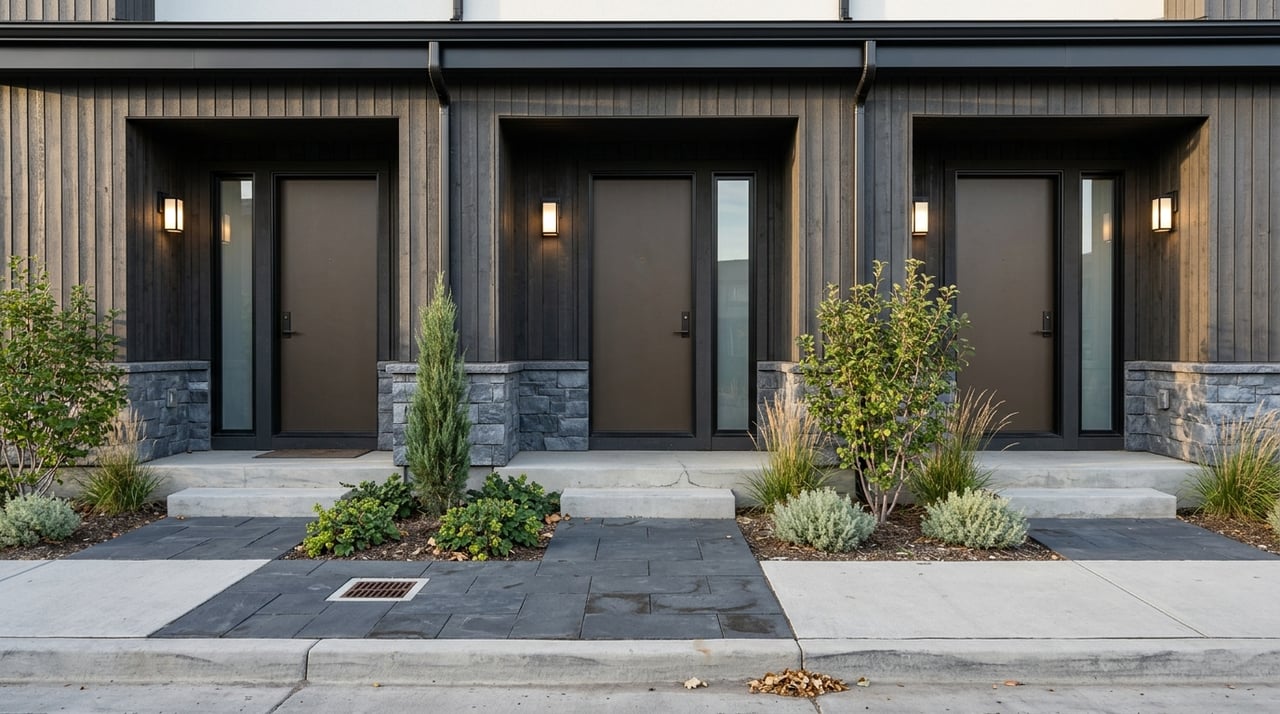
Many second-home buyers start with condos and townhomes because they can offer lower-maintenance ownership and a simpler lock-and-leave lifestyle. In Jackson, though, the property type alone does not answer the short-term rental question.
Town code classifies attached dwellings to include condominiums and attached townhouse units. So a condo or townhome is not automatically eligible, and it is not automatically excluded either.
The real questions are:
In-town condos and townhomes inside the Lodging Overlay are often the cleanest fit for short-term rental use if the project already has approval. Outside the overlay, they face the same residential-zone limits that apply to detached homes, including permit rules and the 3-stay, 60-night cap.
County-approved resort and condo areas show why this matters. Teton County lists approved short-term rental locations such as The Aspens, Golf Creek, Teton Shadows, Teton Village Area I, and Teton Village Area II, with some approvals covering condos only and others extending to townhouses or single-family homes as well.
If you are eyeing a single-family home and hoping for flexible rental income, be careful not to assume that detached means rentable. Inside the Town, single-family homes can be used as short-term rentals only if the parcel is in the right overlay or eligible zone and the owner secures the required permits.
Outside the Lodging Overlay, a detached home still faces the Town’s residential-zone short-term rental limits. So if your income model depends on regular nightly or weekly bookings, those caps may change the math significantly.
If the home is outside Town limits but still marketed as a Jackson property, the rules may be even stricter. Teton County says short-term rentals are prohibited unless the property is in one of the County’s specifically approved resort or condo areas.
Buyers are often surprised by this point. A property with a Jackson mailing address or a Jackson-area marketing description is not necessarily in the Town of Jackson.
In unincorporated Teton County, short-term rentals are generally not allowed unless the property is in a specifically approved area. That makes county due diligence especially important for buyers looking at homes outside Town, in resort corridors, or in outlying mountain neighborhoods.
Accessory units also have separate limits in the County. Teton County says accessory residential units may be rented only to persons employed within Teton County, family members, or guests of the family occupying the main house, and the rental period must be at least 90 days.
So if you were hoping to buy a home with a guest house and use that guest house as a nightly rental, county rules do not support that approach.
If rental income is part of your plan, ask these questions before you get too far into a purchase:
These questions can help you separate a true rental candidate from a property that only looks promising in a listing description.
Past compliance is not just a side note. It can directly affect whether a property is usable for the strategy you have in mind.
The Town says properties found in violation can be barred from receiving another STR BUP for at least five years. County enforcement materials also say properties previously rented in direct violation will not be permitted to continue renting for less than 31 days.
For a buyer, that makes permit history and compliance history part of the underwriting conversation. If a property has a problem in its record, your future options may be narrower than you expect.
Not every Jackson-area purchase needs to depend on nightly rentals. If short-term use is unavailable, limited, or too uncertain, a longer-term lease strategy may still fit the property and your ownership goals.
Because both Town and County materials make clear that 31-day-or-longer leases fall outside the short-term rental rules, some buyers may find that a longer-stay approach creates more predictable use. It may also reduce the risk of buying with unrealistic expectations about permits or occupancy.
The right answer depends on the specific parcel, your intended use, and how much flexibility you want after closing. The important thing is to confirm the rules before you rely on projected income.
Jackson can be a rewarding place to own, but short-term rental assumptions can get expensive if they are not tested early. A condo in the right overlay, a resort-area county property with established approval, and a house outside Town can each look similar in marketing materials while carrying very different rental realities.
If you are buying with income potential in mind, careful local due diligence is not optional. It is one of the best ways to protect your timeline, your budget, and your long-term plan.
If you want a grounded read on a specific Jackson or Teton County property before you move forward, Deirdre Griffith offers thoughtful, locally informed guidance to help you evaluate the opportunity with clarity.

Deirdre Griffith
Deirdre Griffith has called the Mountain West home for over 15 years and enjoys all it has to offer. As a real estate investor herself, Deirdre diligently tracks local residential markets, financial markets, as well as a broad range of ranches and outfits.
Stay up to date on the latest real estate trends.
June 4, 2026
May 28, 2026

May 21, 2026
May 14, 2026

May 7, 2026
April 23, 2026
April 16, 2026

April 2, 2026

March 24, 2026
" Deirdre is hands down one of the best real estate professionals we have ever worked with. At all stages of the journey. “ - Buyer, November 2021